“Building Cities’ Collaborative Muscle”
Stanford Social Innovation Review
Action Insights




Last Updated
Topic
Collaboration
Location
Europe
Tackling the toughest social challenges often requires the public, private, and non-profit sectors to join forces. What do we know about the challenges these partnerships face and how to overcome them? Research supported by the Bloomberg Harvard City Leadership Initiative offers insights for city leaders and their collaborators.
Read the Action Insights below, or download as a PDF for use later.
Most mayors know—or find out the hard way—that when it comes to tackling homelessness, gun violence, traffic congestion, adapting to climate change, or any other tough challenge, city hall cannot do it alone. Municipalities rarely have the resources or authority to solve complex problems on their own. They need partners.
That was the case in the United Kingdom, when South Yorkshire Mayor Oliver Coppard convened a cross-sector group to tackle health inequalities among children. The team included leaders from three local government bodies, a hospital, a non-profit, academia, and the local planning arm of the National Health Service. Coppard tasked the team with an important job: to develop breakthrough ideas to improve health outcomes.
Cross-sector work on something so complex and ambitious makes sense, but collaboration is easier said than done. To unite around a common mission, organizations need to agree on goals, build trust, and reconcile—to some extent—their perspectives, interests, and accountability structures. That can be a tall order and a tough journey.
Academic research supported by the Bloomberg Harvard City Leadership Initiative and published in peer-reviewed academic journals has produced actionable insights for every step of the collaboration journey, from launching teams to scoping work to overcoming difficulties when they inevitably arise.
Understand the Barriers
Cross-sector collaborations often face a similar set of recognized challenges. Local leaders and their partners should therefore enter their work together clear-eyed about the obstacles. The question is not if collaboration will be challenging, but what you will do when you hit a bump in the road, and how you can prepare yourself for that very likely scenario.
Collaboration difficulties stem in one way or another from the fact that participants in any partnership must wear two hats. They must represent the collective interests, goals, and ways of working of the collaboration team. Yet at the same time, they must remain faithful to the priorities of the organization or agency they work for. This dynamic can create friction and doubts, even among partners with shared goals and similar worldviews.
That was true in South Yorkshire when Mayor Coppard’s public health cross-sector team first met. Group members had little familiarity with each other; yet they had been charged with working together to solve a seemingly enormous problem. Some felt daunted and overwhelmed. Others wondered whether the exercise could really accomplish anything meaningful.
A literature review in the journal Public Performance & Management Review scanned 63 studies on this topic and identified three main types of challenges for effective collaboration:
A related empirical study published in Public Management Review, suggested the way collaborations deal with these challenges can make a significant difference. Awareness of the obstacles and knowing they are to some extent inherent to the work can help collaborators anticipate them from the get-go. When tensions do arise, knowing that it’s natural and expected can help the group maintain morale and resolve issues.
Set Up for Success
Another article, in Stanford Social Innovation Review, examines the work involved in overcoming the obstacles. It provides road-tested tools that teams can use to get off to a good start, diagnose problems they encounter, and refine their approach along the way.
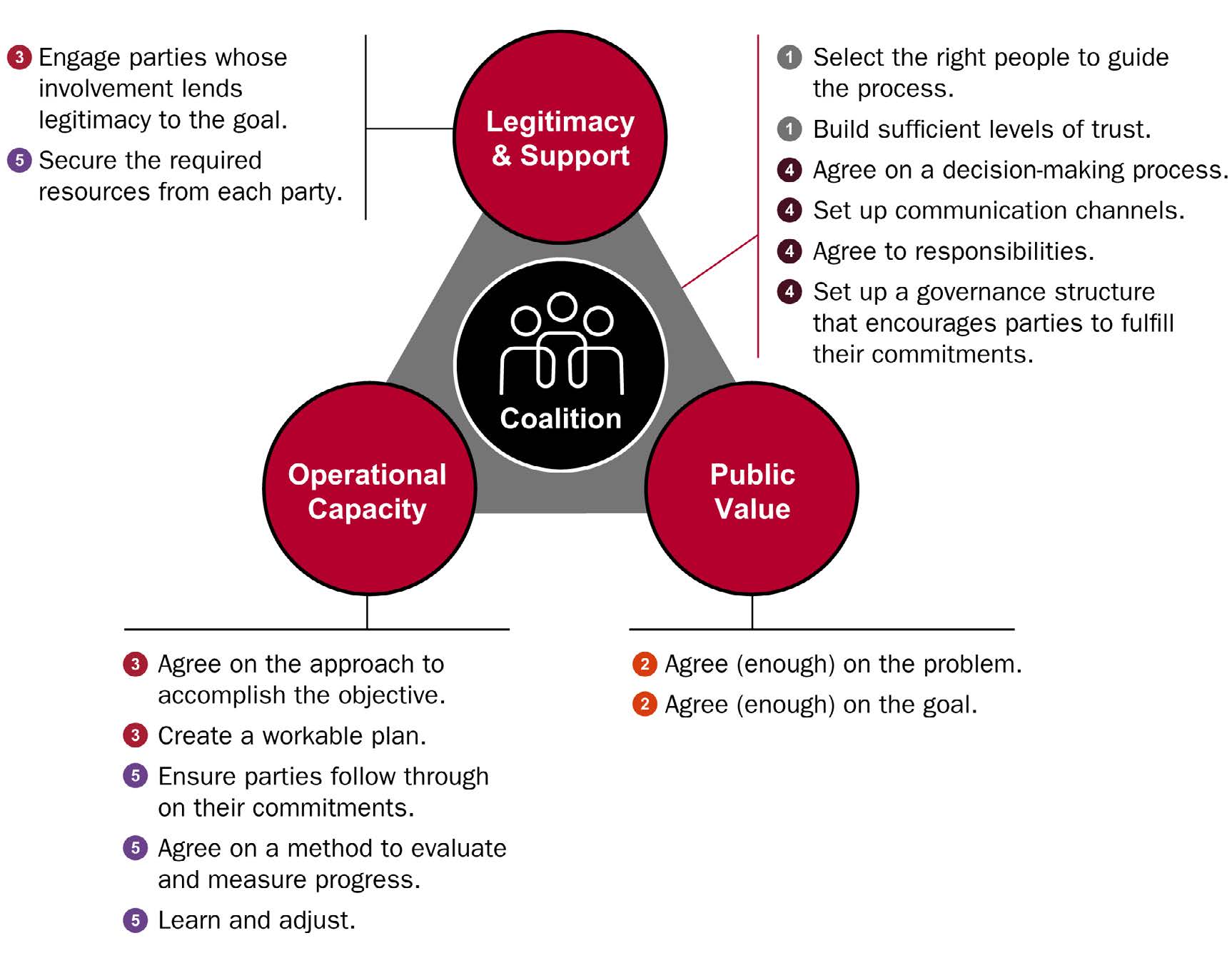
The first tool builds on the Strategic Triangle, a framework from public value theory. The Strategic Triangle for Collaborative Solutions takes the critical tasks needed for collaboration and overlays them with three key dimensions of social problem-solving. Teams can use the tool to understand the tasks every coalition needs to accomplish to be effective and develop a shared view of:
Collaboration teams may find this tool particularly useful during the startup phase, when participants, group goals, and ways of working are established for the first time. It also may be helpful anytime the group is reassessing its tasks and approach.
Figure 1. The Strategic Triangle for Collaborative Solutions
This tool outlines the tasks needed for a successful collaboration. The suggested sequence— steps 1 through 5—reflects a scenario where parties start with a blank slate and have control over the effort’s design.
Adapted from: De Jong et al., “Building Cities’ Collaborative Muscle,” Stanford Social Innovation Review, Spring 2021.
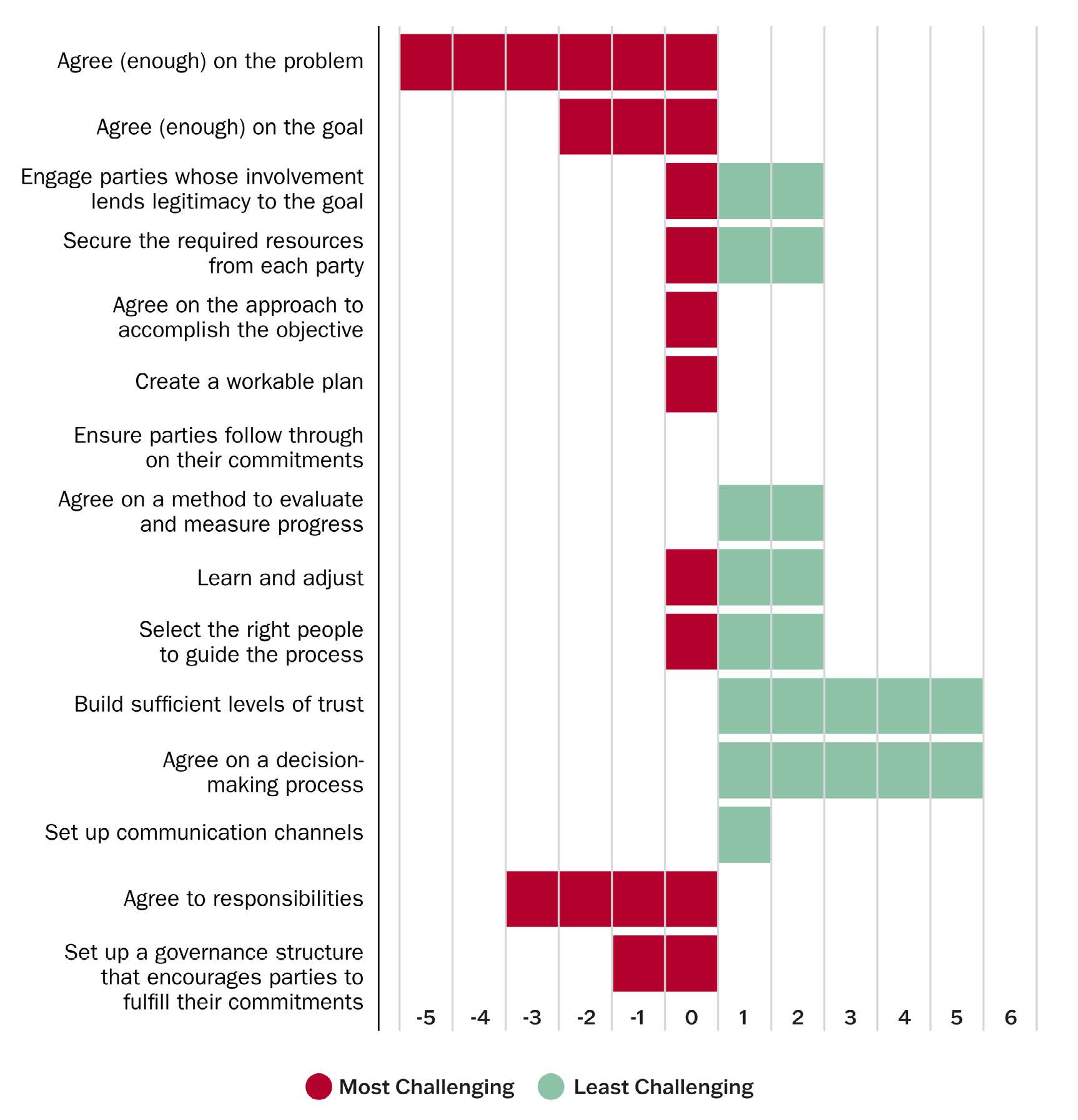
The second tool is more like a tune-up for teams that are already up and running. Groups can use the Barrier Prioritization Tool to surface lingering tensions and address issues that may be interfering with their work. Each team member reflects on the 15 collaboration barriers and ranks the ones they believe are most and least challenging for the group. The team then discusses the aggregate results. This exercise has been shown to help parties working in cross-sector collaborations build trust, maintain alignment, and strengthen their work together.
In South Yorkshire, the children’s health cross-sector team took early steps to get in sync. For example, the group enshrined some basic principles of how they would work together in a group constitution, established a biweekly meeting cadence, and set up a WhatsApp group as their main communication channel.
Mayor Coppard also made some shrewd choices to lend the group’s work authority and legitimacy. All of the team members he asked to join held senior positions within their organizations, meaning they could bring resources, make decisions, and contact the heads of other organizations that could help. In addition, Coppard made clear that he would back the group’s recommendations, reinforcing the sense both inside and outside of the team that its work would be consequential.
Figure 2. Discussing Barriers: One Example of a Ranking Exercise
Adapted from: De Jong et al., “Building Cities’ Collaborative Muscle,” Stanford Social Innovation Review, Spring 2021.
Get Going and Build Momentum
By their nature, cross-sector groups are often tasked with complex problems with no easy answers. Workforce development. Poverty. Affordable housing. Domestic violence. Faced with such multifaceted issues, teams often become mired in debate and analysis and struggle to figure out where, exactly, to start.
That’s the focus of an article in the Journal of Applied Behavioral Science. Researchers studied the early stages of 10 teams working on thorny social issues. Key to making progress was not immediately trying to tackle the whole problem in all its complexity. Rather, the most successful teams identified a manageable entry point into the work, where they could get moving, learn, adapt, and build momentum.
There’s no such thing as a perfect entry point. But some work better than others. The researchers found that the most productive entry points are:
Finding a suitable way into the work turned out to be critical for the South Yorkshire team. When the group first looked into children’s health, it was easy to get frustrated by all the things it had absolutely no control over, such as social housing policy in the UK or low wage growth for workers. However, the team members’ initial conversations also uncovered an insight that they would come back to: one in nine newborns in one of South Yorkshire’s communities had no bed, crib, or bassinet to sleep in when coming home from the hospital; some babies slept on floors or in bathtubs. Not only was “bed poverty” a critical subcomponent of the larger children’s health issue, but it was a problem group members could wrap their heads around.
The research found other ingredients of success during these difficult early stages. Teams that were most effective at finding entry points had diverse representation and a wide variety of perspectives. They had built trust amongst team members, often by using deliberate strategies meant to build empathy and psychological safety. And they had generated a sense of agency and shared belief that their work together could actually make a difference.
Also important is what comes after a team chooses their entry point. That is the focus of the study in Public Management Review mentioned earlier. It looked at eight cross-sector collaborations aimed at fighting different aspects of organized crime in the Netherlands over a period of 18 months. The study assessed why some of these initiatives got stuck and others did not.
In addition to finding suitable entry points, the study found, the most successful collaboration teams adopt a “both/and” mindset. That is, rather than getting stuck on the contradictions and tensions inherent in collaborations, participants accepted that they were part of the work and moved on together. While that’s easier for some people to handle than others, effective team facilitation can help nurture this mindset.
Learn from Setbacks
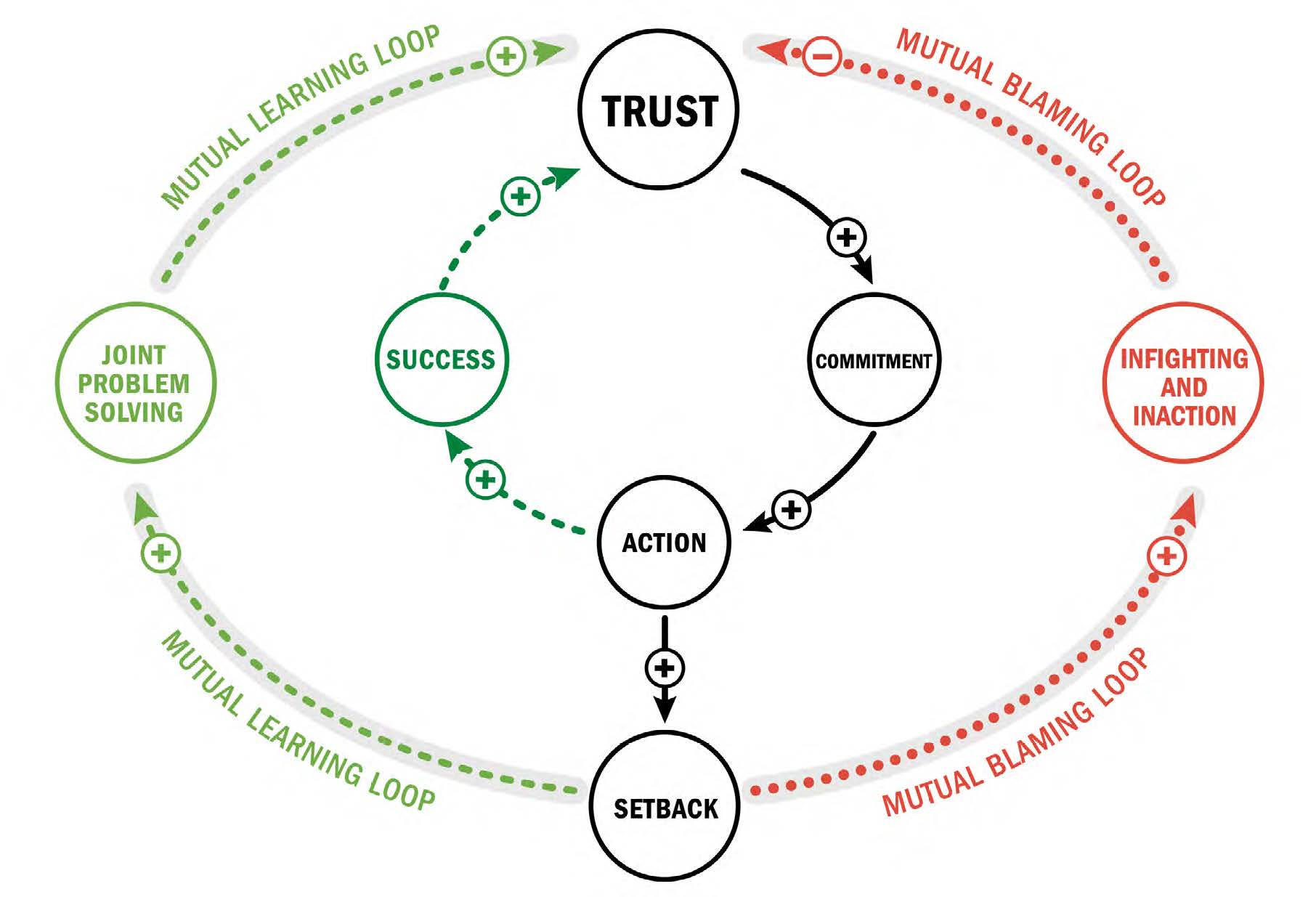
Given the barriers to collaboration, it’s all but inevitable that teams will face moments of failure along the way. How they respond to those setbacks matters. That’s one finding of a study that looked at nine cross-sector collaborations related to education, public safety, and economic development in three U.S. cities. The paper was published in the Journal of Public Administration Research and Theory.
A baseline of trust is necessary for any collaboration to get started. But unexpected problems such as funding cuts, personnel changes, crisis, or conflicts can strain those bonds. When that happens, cross-sector collaborations that invest in mutual learning are more likely to reinforce trust in the group and overcome the challenges. Approaching setbacks as a joint problem-solving challenge can help groups figure out what went wrong, adjust, and bounce back. Those that don’t do this are more likely to grind down in disagreement and finger-pointing.
Figure 3. Mutual Learning and Mutual Blaming Loops
Source: Pulido-Gómez et al., “Cross-Sector Collaboration in Cities: Learning Journey or Blame Game?” Journal of Public Administration Research and Theory, 2025.
The research identified five steps cross-sector teams can take to strengthen their capacity for mutual learning and improve odds of success. Those include:
Takeaways
Cross-sector collaboration is challenging—but essential. Municipalities can go farther faster when they combine the resources, expertise, and networks of government, non-profits, business, philanthropy, and academia. To maximize the payoff:
In South Yorkshire, the cross-sector team’s recommendations led Mayor Coppard to launch a new program called Beds for Babies: Safe Space to Sleep. Launched in 2024 with about $3 million (£2.2 million) in local funds and donations from IKEA and others, the program provided a free Moses basket, cot, or toddler bed to any child under the age of 5 who needed one. The program began through a series of four pilots testing different service and delivery models to find out what worked best. A year in, the effort had distributed its 1,000th bed.
Everyone involved in the program recognized that beds alone wouldn’t solve the poor health outcomes South Yorkshire’s children faced. But it gave the community a starting point to experiment, learn, and adapt, as well as knowledge about how to manage cross-sector collaborations needed to take the community’s work in children’s health to the next level.
“It’s a brilliant place to start, right at the start of a child’s life,” Mayor Coppard told a local newspaper shortly after the program launched. “This is not the end of our investment in this space. It’s just the start.”
Journal of Applied Behavioral Science: Eva Flavia Martínez Orbegozo, Jorrit de Jong, Hannah Riley Bowles, Amy Edmondson, Anahide Nahhal, Lisa Cox
Journal of Public Administration Research and Theory: Santiago Pulido-Gómez, Jorrit de Jong, Jan W. Rivkin
Public Management Review: Maurits Waardenburg, Martijn Groenleer, Jorrit de Jong, Bas Keijser
Public Performance & Management Review: Maurits Waardenburg, Martijn Groenleer, Jorrit de Jong
Stanford Social Innovation Review: Jorrit de Jong, Amy Edmondson, Mark Moore, Hannah Riley Bowles, Jan Rivkin, Eva Flavia Martínez Orbegozo, Santiago Pulido-Gomez
Stanford Social Innovation Review
Bloomberg Harvard City Leadership Initiative
Stanford Social Innovation Review
Stanford Social Innovation Review
More Resources Like This
Simulation
Collaboration, Innovation

Module
Data and Evidence, Innovation

Module
Collaboration